We had the fortune to spend about six months in Landour, a beautiful little township and surrounding villages, close to the popular hill station Mussoorie, Uttarakhand. Situated at about 2200 m above sea level in the Himalayas, Landour itself was stunningly beautiful with its views of snow-clad peaks, small bazars, oak and pine forests and the numerous trails that one could explore. A popular destination about 20 km east of Landour is Dhanaulti. I have been there a few times, but only once with the intention of herping.
 |
A fair weather view from Dhanaulti.
|
In 2015, I went with a bunch of students and
herpetologists to Dhanaulti. It was the field trip part of their 'herpetology workshop' conducted at Wildlife Institute of India, Dehra Dun. With us were veterans of the field like
Indraneil Das and
Ulmar Grafe. Camping at a hotel in Dhanaulti, we went out for a walk along one of the paths leading away from the road, through a patch of forest. It was October, and the cold evening wind at that altitude was already making me shiver a little. We crossed several small streams, until we reached a somewhat larger one away from the road. Ulmar was teaching about sampling herpetofauna along streams, measuring water flow, slope of the stream etc. As night fell, the mood shifted to more of casual herping, headlights came alive, and people started moving in small groups looking for animals.
 |
Woods near Dhanaulti, a mix of deodar and oak forests.
|
 |
One of the forest streams.
|
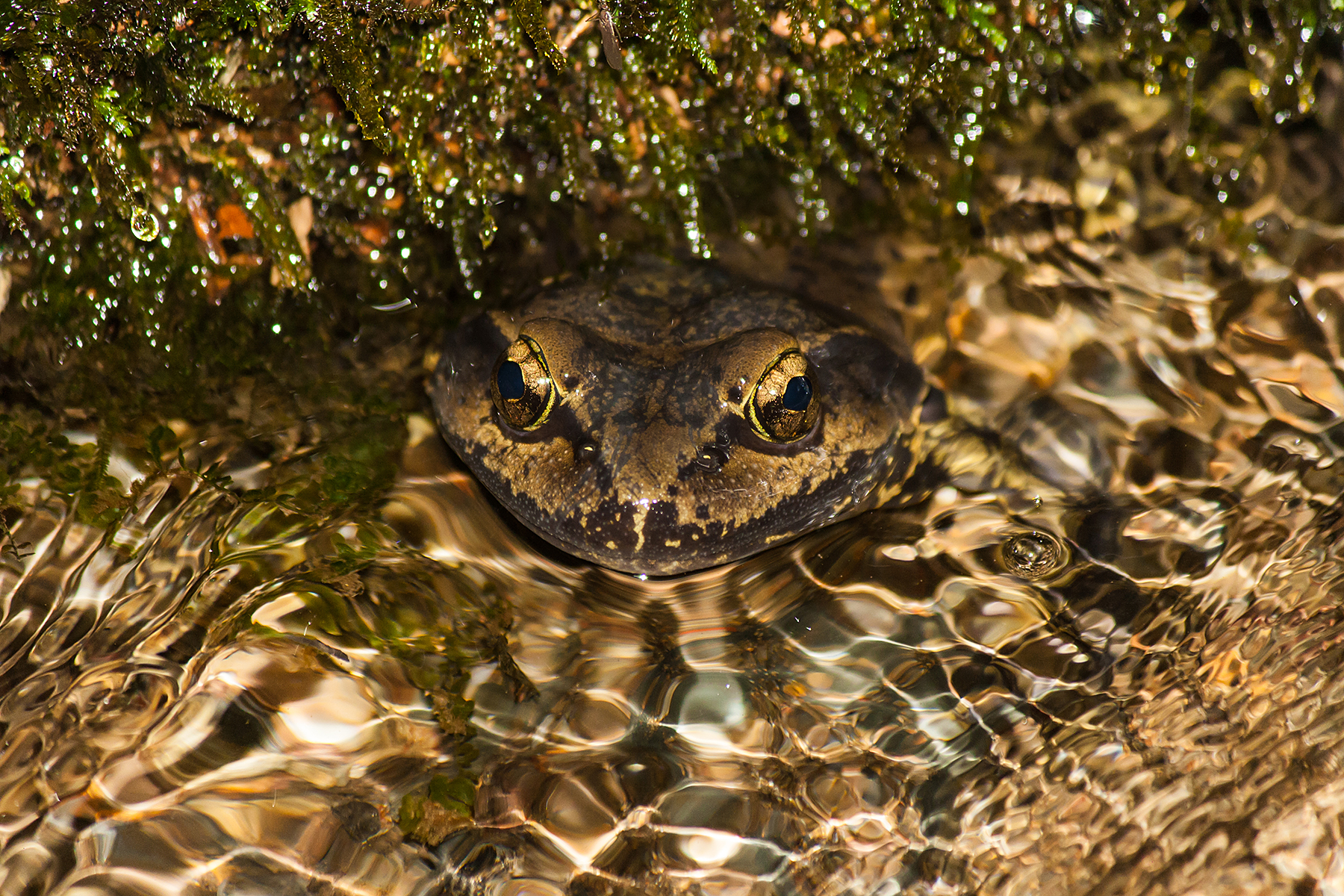
I wanted to find and photograph frogs and reptiles in the wild as they are. Having a lot of enthusiastic people around is sometimes not the best way to do it. So I tried to pull away from the group and moved up the stream. As I walked up the boulder-strewn stream with a dimmed headlight, I could see pale red eyes shining at me from the edge of water, or under a boulder. Approaching quietly and without closing the light, revealed a pair of eyes just above the water level, attached to the chunky body of a rather large species of frog. These were Murree Frogs (Nanorana vicina). Nanorana is a bit of an odd name for these, there was nothing nano about them (nano = small, Rana = frog). I approached the first one, carefully on my hands and knees to within a few feet, held the camera up to find the frog in the view finder, and gently pressed the shutter-release to focus, "beep". A small splash, and frog disappeared into its watery home below the boulder. I sat cup, cursed my poor old camera, switched off the focus confirmation sound, and proceeded to find more frogs before people behind caught up. Eventually, I managed to photograph a few.
Normally, herping in a stream means getting the feet (sometimes the whole body) wet. But I put one foot in the water here and that was enough. The air temperature was around 13°C, but I swear that water felt like near zero. It hurt my foot! I have no idea how those frogs were staying active in that water. I have heard of wood frogs in Alaska that can survive freezing. Could these Himalayan frogs also do the same? We know that a related species from the Tibetan plateau, Nanorana pleskei is can survive hibernation temperatures as low as - 2.5°C, even when more than 1/4th of the body fluids were frozen. Frogs in Dhanaulti probably do not experience anything that severe. But they are thought to be a wide-spread species in the Himalayas, and I am curious to know how frogs in colder parts survive.
 |
These frogs blend in well with stream environment.
|
 |
Taking the 'cold-blooded' to a whole knew level.
|
 |
This one was at the edge of a small, but deep pool.
|
 |
Look at that face, its almost saying,"just take your photo and move along".
|