“A
true arboreal lizard, tolerably common at the Andamans and very common
at the Nicobars. I found the jungles on Nancowry and Camorta swarming
with specimens. They were extremely quick, and almost within a moment
would ascend 20 or 30 feet up a tree; when followed they would leap from
one tree to another. Without shooting them it was scarcely possible to
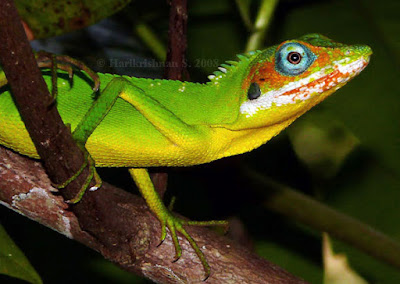
secure a specimen…” wrote Ferdinand Stoliczka, the 19th century explorer and naturalist. Apparently, Bay Island forest-lizards (Coryphophylax subcristatus)
don’t care what 19th century herpetological literature says about them:
the male in front of me seemed to have no intention of running away,
and I had no intention of shooting him. He was more interested in
showing his strength. He performed a few push-ups and menacingly nodded
his magnificently ornamented head with a high fold of skin behind the
neck upon which stood numerous curved spines. The brilliant yellow and
black gular pouch (an extension of the skin under the chin and throat,
supported by a little cartilage) was expanded to its fullest.
Impressive! I lowered my fishing line noose towards him, but before I
could slip it over his head, he lunged towards it and bit the line! A
flick, a catch, and he was in my hands, the gular pouch still extended
in a threatening way. Ten minutes later, freed after an embarrassingly
detailed physical examination for any self-respecting lizard, he was
still not ready to flee, but continued to threaten with head bobs!



Walk
into any jungle in the Andaman and Nicobar Islands and this forest
lizard will be the first animal one sees (exception is Great Nicobar
Island where, for some reason, they are not found). Bay Island forest
lizards (I hate this common name, which shows a great paucity of
imagination among current herpetologists L)
show a great variety of patterns and body shapes among different
islands, with some of the more remote islands harboring gigantized
forms. They live on the forest floor, on buttress roots and the trunks
of trees, making up a major chunk of the animals one sees in the forest.
Look higher up in the trees, and one might see an altogether different
Agamid lizard. If you are in the Nicobars, depending on the island, you
might see a Green crested-lizard (Bronchocela cristatella) aggressively displaying to his rivals from a high branch, or a Red-throated long-tailed agama (Bronchocela rubrigularis) basking in the spotlight sunshine, or a much smaller Daniel’s long-tailed agama (Bronchocela danieli)
watching your every move. However, to find each of these, you have to
travel from island to island in the Nicobars, for they do not seem to
like sharing home with a cousin, though they do live in harmony with our
ubiquitous Bay Island forest-lizards.

Another
group of abundant lizards is the skinks. Ten species of these shiny
fast lizards are known from these islands. These include what is
probably one of the largest if not the largest skink in India, Tytler’s
skink (Eutropis tytleri) that grows to half a meter in total length and the diminutive Large-eared skink (Lipinia macrotympanum) that is known from only a few specimens. In the Nicobars occur the tree skinks (Dasia
spp.). As a group, I find skinks the hardest of all lizards to catch
because of their shiny, smooth, muscular bodies and the extreme
quickness with which most species move. Tree skinks take these
difficulties to a whole new level. Chasing a skink on the forest floor
is hard enough, but chasing one around a tree in a rainforest full of
thorny/spiny canes is something else. Then again, no pain no gain, and
love the skinks for beating me almost every time.
Come night, hosts of other scaly creatures take the lead role. Walking along a jungle trail on a summer night, one
suddenly hears the loud “trrrrrk.......TOK TOK TOK TOK TOK
TOK.......................”, and if you are a first-timer in these
forests, you may be excused for thinking of a fearsome creature lurking
high above in the canopy waiting to pounce on you as soon as your torch
light dies. In reality, that sound would be the call of a giant gecko.
There are two species in these islands, and like many others of their
kind here, the two like to keep a distance from each other. The Andaman
giant gecko (Gekko verreauxi) is found only in the Andaman Islands, while Smith’s giant gecko (Gekko smithi)
occurs in Great Nicobar Island. Both these geckos can be more than a
foot in length and are powerful predators. The characteristic mouth-open
warning position that they adopt is no bluff, for those jaws can clamp down
like a steel pliers, as any careless herpetologist who was trying to
measure the head length of the animal would testify. The islands in
which these two species occur are separated from each other by more than
500 km of sea! Several other islands in the Nicobar lie between the
Great Nicobar and the Andamans. Here occurs yet another fascinating
species of gecko. The first time I saw one in the Island of Car Nicobar,
I mistook it for a falling leaf. However, my fallen leaf grabbed a leaf
insect as it fell, and started moving back up a tree! That was a
Nicobar gliding gecko (Ptychozoon nicobarensis). They are not as
big as the heavy weight giant geckos, but are still big for gecko
standards. The skin extensions that act like a parachute as the animal
glides down from a tree also help it camouflage against the bark.
Curiously, these animals have a habit of communal egg laying, and I once
saw a number of small white orbs stuck to a tree trunk high above the
ground.

In
the absence of large mammals, except the small version of the wild pig,
lizards in these islands are key players in the ecosystem. Is the
extremely high abundance, and thus the contribution to animal biomass, a
result of reduced competition between species? Or is it because of
fewer number of predators? What about competition with insectivorous
birds? What about the possibility of high abundance of insect prey
(whatever be the reasons for that)? Scientists around the world have
used them to study every aspect of ecology, evolution and biogeography.
But we still have a long way to go before we can get under the scales
that cover their secrets.


